


We have new prompts this week! This time around, we asked an AI to give us random surreal short prompts to work on, and we each chose one. So the stories have range, but they also conceptually overlap a bit. The titles are the prompts. Tell us what you think!
A Clock Bloomed
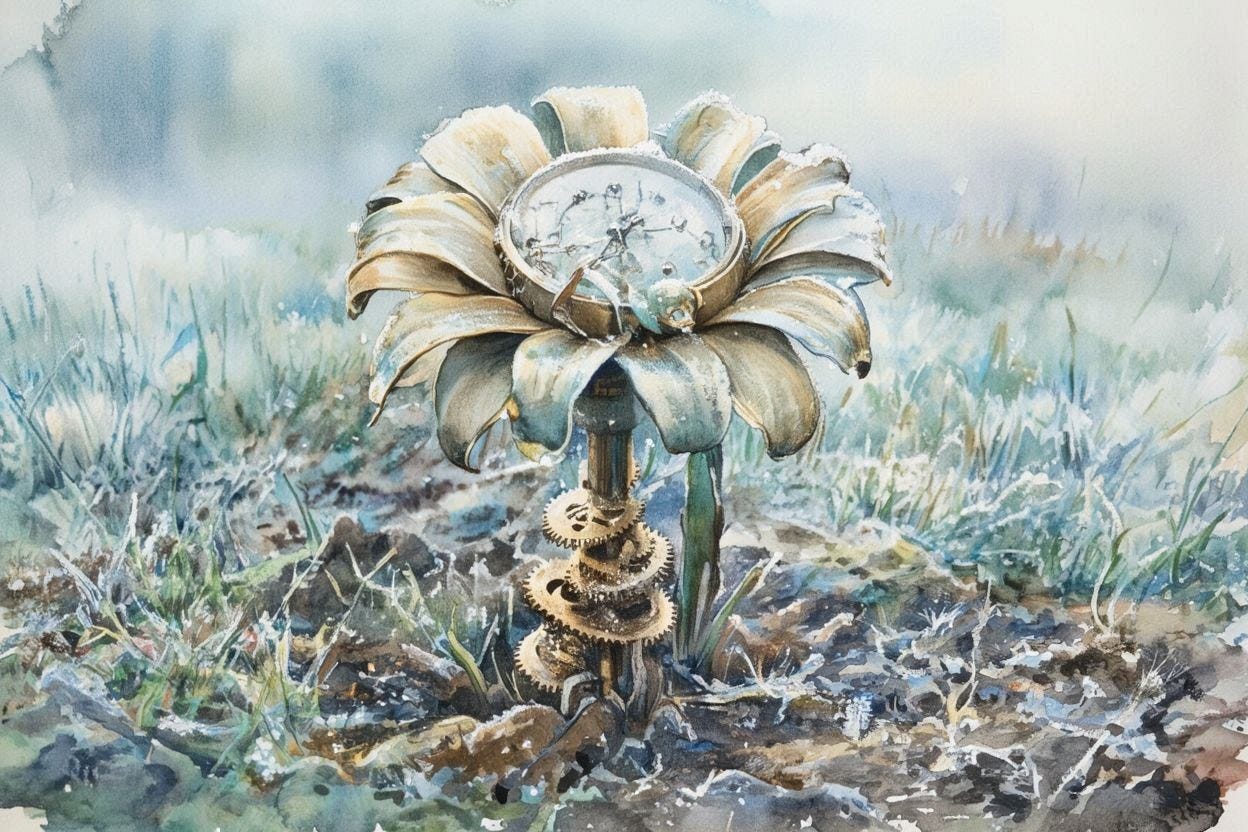
A clock bloomed in the center of the garden the morning after the last frost. No one planted it. No one claimed responsibility. It rose from the soil like a pale mechanical flower, its brass petals unfurling with a soft, decisive click, as if time itself were stretching after a long sleep.
Mara was the first to see it. She had come outside with her usual intention (to check whether anything had survived the winter’s final tantrum) but the sight of the clock halted her mid‑step. It stood about knee‑high, its stem a slender column of interlocking gears that turned with the slow confidence of something that had always known how to move. The face of the clock was translucent, like thin ice, and behind it tiny hands circled in patterns she didn’t recognize.
She crouched beside it. The air around the clock felt warm, almost summerlike, and carried a faint scent of oranges. When she reached out, the petals shivered, not in fear but in acknowledgment, as though it had been waiting for her.
By noon, the neighbors had gathered. They whispered theories—art installation, prank, omen, malfunctioning drone—but none of them dared touch it. The clock continued its quiet rotations, shedding a soft golden dust that settled on the grass and made it glow faintly. Children tried to catch the dust in their palms, giggling when it tingled like carbonated water.
Mara stayed closest. She felt, without knowing why, that the clock was hers. Or perhaps she was its. When she leaned in, she could hear something beneath the ticking: a layered murmur, like overlapping voices speaking in a language she almost understood.
That night, she dreamed of the garden. The clock had grown taller, its petals wider, its hands moving in spirals instead of circles. Time in the dream bent around it—stretching, folding, looping back on itself like ribbon. She saw herself as a child, then as an old woman, then as someone she didn’t recognize but felt intimately connected to. When she woke, the dream clung to her like dew.
The next morning, the clock had indeed grown. Only by an inch, but unmistakably. Its petals had deepened to a burnished copper, and the warm air around it pulsed gently, as though it were breathing. Mara touched the stem. It vibrated faintly, like a cat purring.
Days passed. The clock continued to bloom, each new petal adding a new sound to its chorus. The neighbors stopped visiting. They said it made them uneasy, that the ticking followed them home, that their dreams had begun to warp. Mara didn’t mind. She felt steadier near it, as if the clock were tuning her to a frequency she’d forgotten she could hear.
On the seventh morning, the clock opened fully. Its petals spread wide, revealing a hollow center filled with swirling light. The hands inside dissolved into threads of brightness that drifted upward like seeds on a breeze.
Mara stepped closer. The warm air wrapped around her. The murmuring grew clear.
It was her name.
And when she answered, the clock welcomed her in.
Yesterday Glass
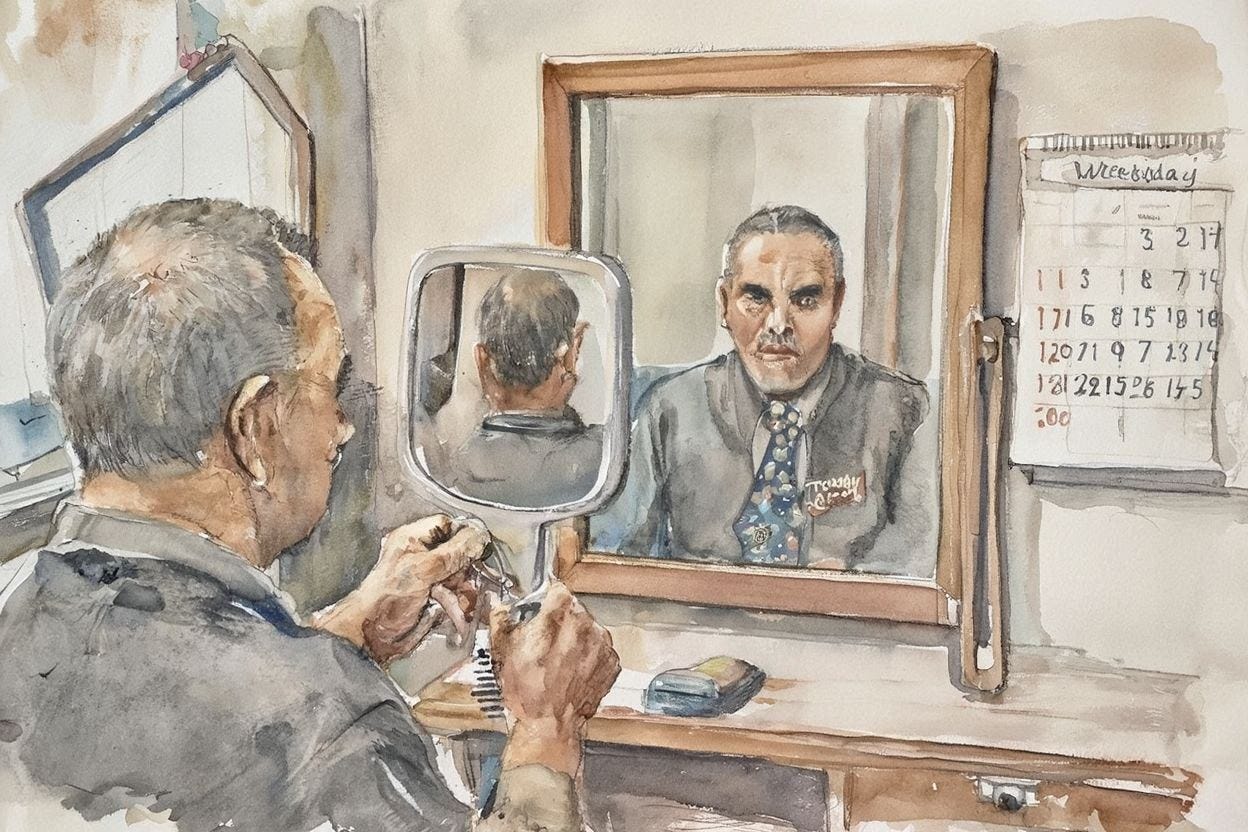
The first report came from a barber on Veldt Street, who noticed that the man in his mirror was wearing a Tuesday tie on what was clearly a Wednesday morning. He said nothing (barbers are a discreet profession) but he angled his own mirror away from himself for the rest of the day and worked by feel alone.
By noon, the whole city knew.
The mirrors had slipped. They had not broken, nor had they cracked. No mirrors had gone dark the way mirrors do in houses where someone has died. No; the mirrors simply showed yesterday. The bathroom mirror gave you your face from twenty-four hours prior. Shop windows reflected the previous afternoon’s crowds, bustling with purpose through a Thursday that had already been spent. The great mirrored facade of the Aldermanic Tower played Wednesday’s clouds across its surface while Thursday’s rain fell in the street below, and nobody standing under an awning could quite decide how to feel about it.
Philosophers were contacted. Several of them declined.
A television anchor held a compact mirror to the camera and showed her audience yesterday’s broadcast already playing inside it. “We are,” she said carefully, “looking into the past.” She paused. “Twenty-four hours is not very far.” She paused again. “And yet.”
People became strange around their own reflections. A young woman brushed her hair in front of her bathroom mirror and watched her yesterday-self do the same, and she found she could not remember if she had been sad then or only looked it. A retired postal worker sat in front of his hallway mirror for the better part of an afternoon, trying to catch himself doing something he didn’t remember. He never did. This comforted him in a way he couldn’t explain to his daughter, who called twice.
The blind moved through the city with new authority. They had always navigated by other means, like by echo and texture, or by the smell of the bakery on Carn Street, and by the particular give of the cobblestones outside the old post office. They knew what day it was because they had lived it arriving, hour by hour, in the ordinary way. Sighted people stopped them and asked, “What day is it? What time? Is this still morning?” The blind answered patiently, honestly, with a generosity born of long practice at being asked for things they were not expected to have.
A child asked her mother why the mirrors were broken. Her mother said they weren’t broken, exactly. The child asked what exactly meant. Her mother looked at her own hands, which were not in any mirror, and were therefore unambiguously present-tense, and said: it means the mirrors got confused about which moment was worth keeping.
The child accepted this. Children accept things that adults find shattering, because children still understand, dimly, that time is not as fixed as furniture.
By Friday, the mirrors had corrected themselves. Nobody could say how.
But for weeks afterward, people paused before their own reflections, half-expecting to find someone they’d already been.